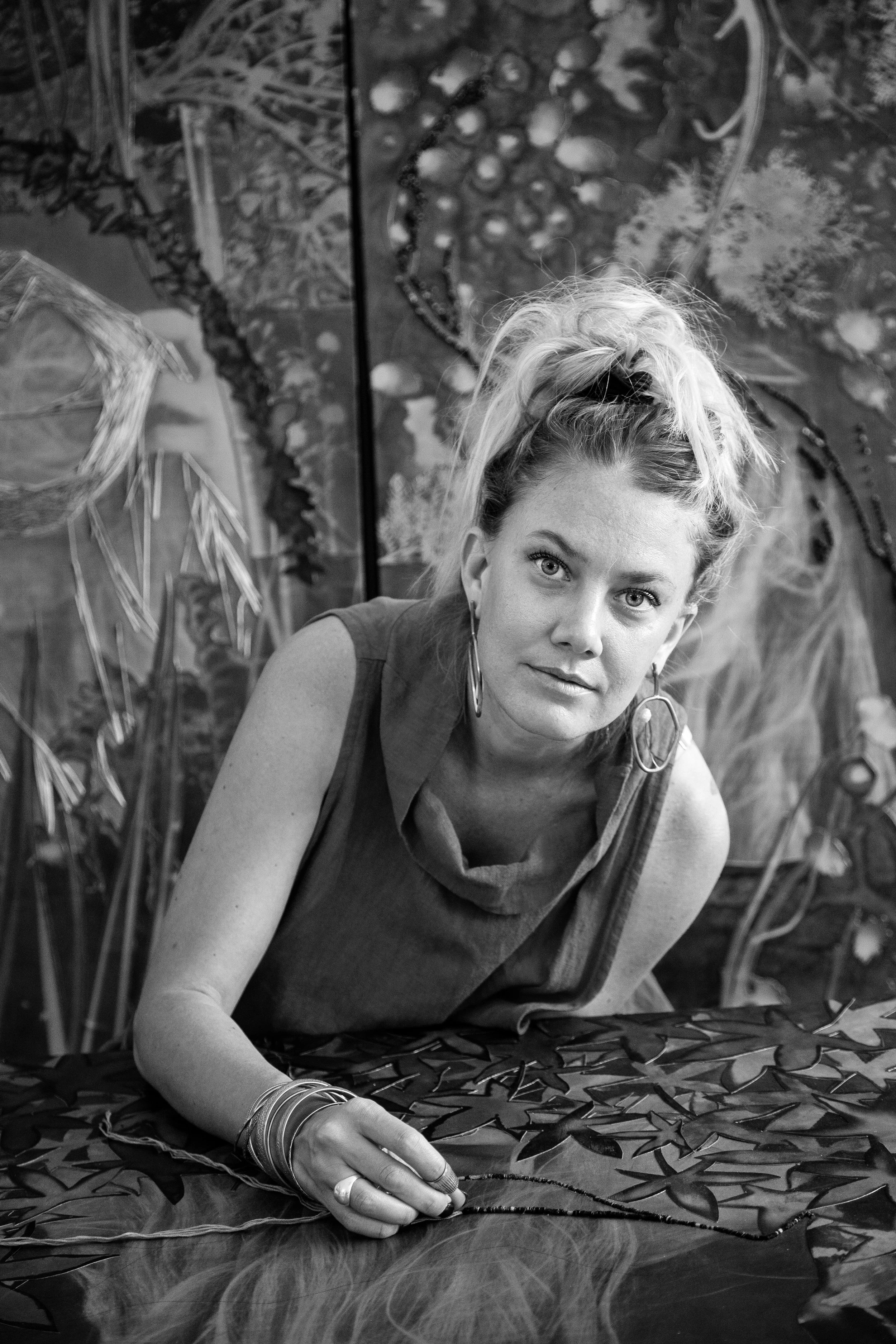
Kandice Kardell is a visual artist and educator originally from the Sonoran desert, where the vastness, textures, and material conditions of the landscape continue to inform her work. Since 2021, she has been based in Portugal, living and working near the sea—an ongoing geographical shift that shapes her engagement with land, water, and ecological process.
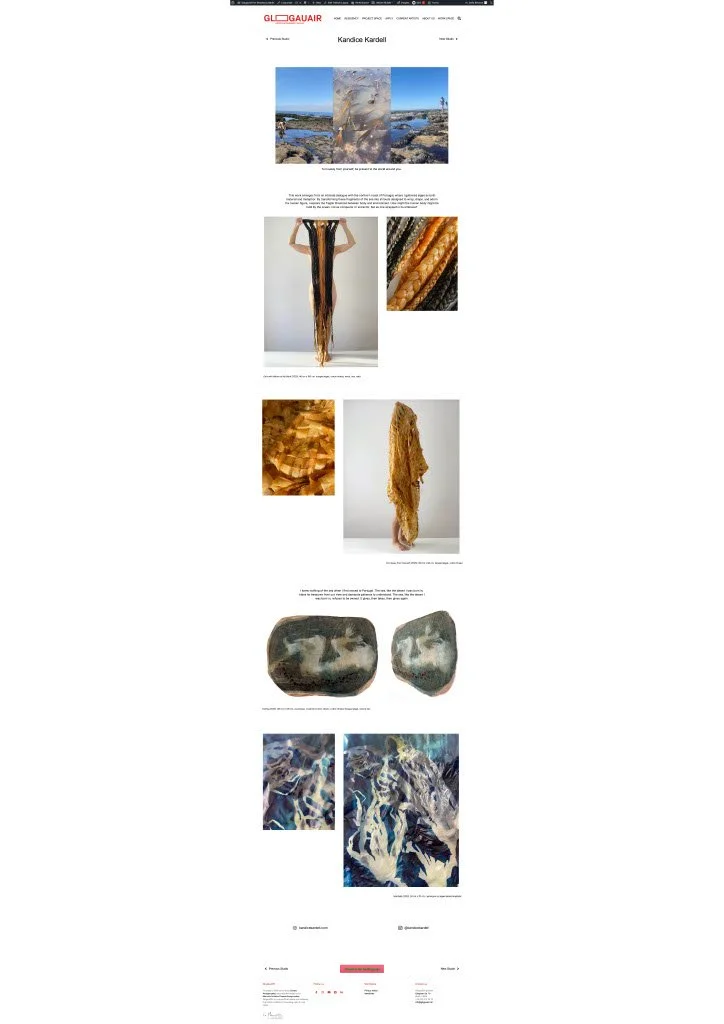
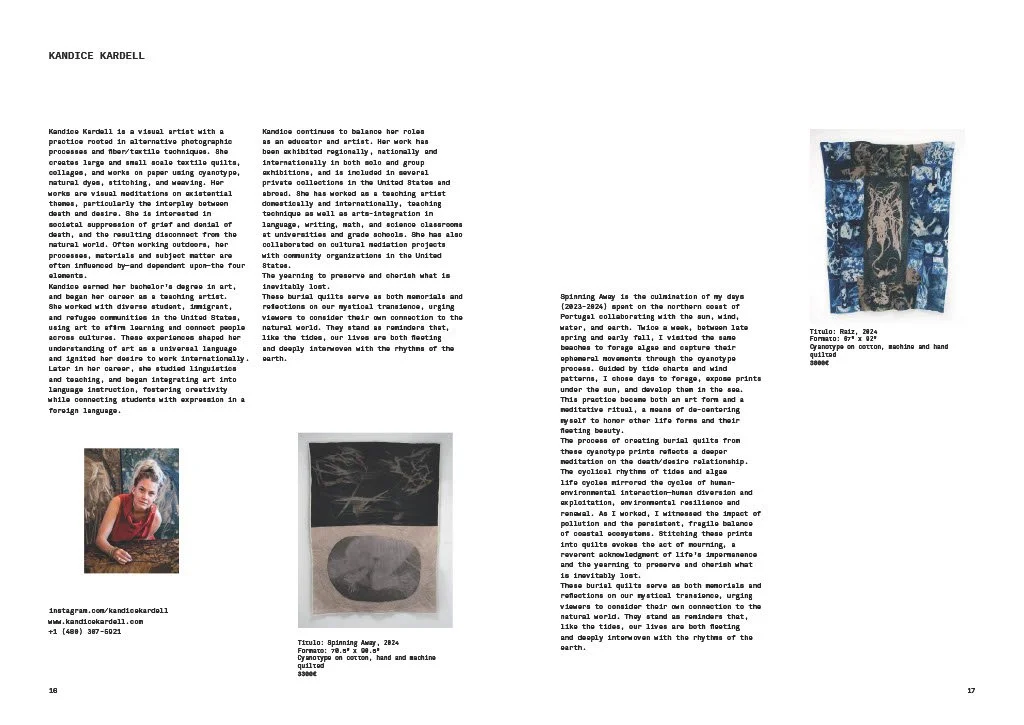
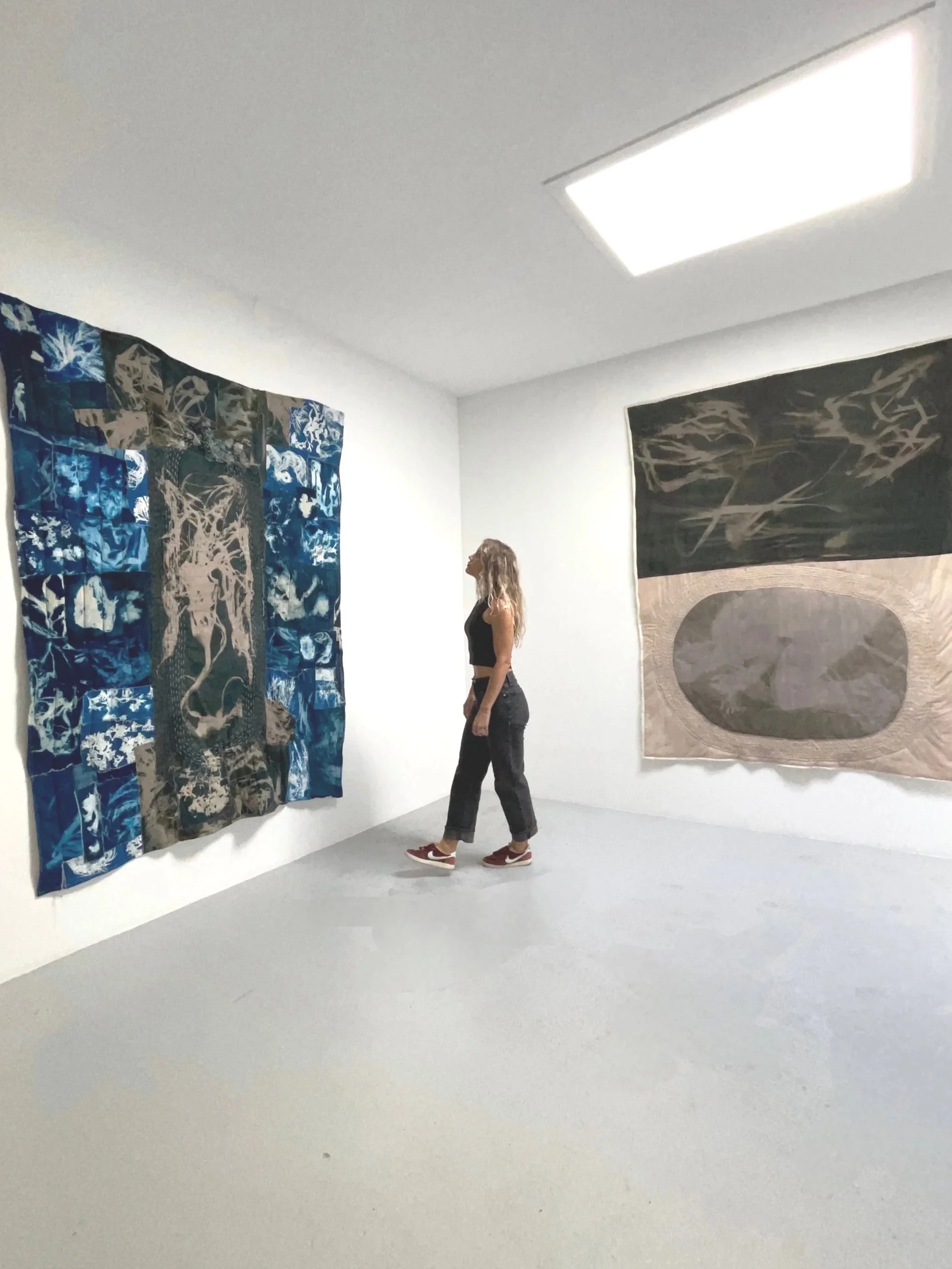
Kardell creates two- and three-dimensional textile works using foraged and harvested algae as both material and subject. Through biomaterial research, weaving, stitching, solar printing, and plant-derived dyes, she transforms algae into shroud-like forms, sculptural objects, and wall-based works that explore the relationship between body, landscape, and ecological change. Working with materials that are both long-lasting and biodegradable, her practice examines impermanence, mortality, and more-than-human entanglements through processes shaped by environmental conditions, time, and touch. Guided by ecological grief and the philosophy of un-selfing, Kardell’s work invites viewers to encounter mortality and loss not as endpoints, but as shared ecological processes unfolding through cycles of transformation and return.
Kardell holds a bachelor’s degree in art and a master’s degree in English. She began her career as a teaching artist, working with diverse immigrant and refugee communities in the United States, experiences that shaped her belief in art as a universal language capable of crossing cultural and linguistic boundaries. Her background in linguistics and education led her to integrate art into language instruction and interdisciplinary learning across university and K–12 settings.
Her work has been exhibited regionally, nationally, and internationally in both solo and group exhibitions, and is held in private collections in the United States and abroad. Alongside her studio practice, Kardell continues to teach and collaborate on arts-integration and cultural mediation projects worldwide, exploring the intersections of art, education, ecology, and communication.

-
2026
Art’n Fiber, Quilt Academy of Sweden, Uppsala, Sweden2025
GlogauAIR Online, GlogauAIR, Berlin, Germany2019—2021
Tempe Studio Artist, Tempe Community Arts, Tempe, AZ2018—2019
Teaching Artist, Molly Blank/Kennedy Center Teaching Artist Program, Arizona State University, Tempe, AZ2007—2009
Teaching Artist, Changing Worlds, Chicago, IL2006—2007
Teaching Artist, After School Matters, Gallery 37, Chicago, IL -
2026
Living Surface, solo exhibition, Manywhere Gallery, Porto, Portugal
2024
Spinning Away, solo exhibition, Allmo Gallery, Porto, Portugal2023
Portraits and Stills, solo exhibition, Cave Bombarda, Porto, Portugal2021
Distanced, Desert Crafted, Phoenix, AZ, USA
2000
Synapse, Art One Gallery, Scottsdale, AZ, USA -
2026
IGNITION, group exhibition, A Homem Mau, Lisboa, Portugal
2025
Resonant Matter, trio group exhibition, Allmo, Porto, Portugal
Virtual Open Studios, group exhibition, GlogauAIR, Online
MESCLA, group exhibition, Outsite Mouco, Porto, Portugal
TOWARD 2050, group exhibition, Desert Botanical Garden, Phoenix, AZ
2024
100x100x100, group exhibition, Atelier 968, Porto, Portugal
Co-Crafting Democracy: Fiber Arts and Activism, group exhibition, Women of the Hall, Seneca Falls, NY
2021
Light Sensitive, juried group exhibition, Art Intersection, Gilbert, AZ, USA
2020
Light Sensitive, juried group exhibition, Art Intersection, Gilbert, AZ, USA
2019
Choice Cuts 3, group exhibition, The Lodge, Phoenix, AZ -
2026
Algae, Textiles, and Ecology: Making Yarn from Seaweed, Manywhere Gallery, Porto, PT
Algae Cyanotypes: Experimental Botanical Printing and Toning, Manywhere Gallery, Porto, PT
Artist Talk, GlogauAIR, Berlin, Germany
2019—2020
Mathematical Printmaking, arts integration workshop (series), Tempe Community Arts, Tempe School District #3, AZ
2019—2020
Artist Books (series), Tempe Community Arts, Tempe School District #3, AZ
2017
Using Visual Literacy to Support Critical Thinking, and Writing, CamTESOL, Phnom Penh, Cambodia
2016
Cultural Identity and Visual Storytelling, arts integration workshop (series), Access Microscholarship Program, Hpa-An and Hopone, Myanmar
Visual Literacy for the EFL Classroom, arts integration workshop(series), Access Microscholarship Program, Mawlamyine, Myanmar
2009
Judaism and Islam: Collaborative Quilt Making, youth workshop, KAM Isaiah Israel, Chicago, Illinois
Printmaking and Reflective Practices of Sankofa, arts integration teacher training, Whittier Elementary School, Chicago, Illinois
2008
Roots: A Community Map of Immigration, community workshop, Albany Park Community Center, Chicago, Illinois
2007—2009
Silk Painting and Family Oral Histories, arts integration workshop (series), Changing Worlds, Chicago, IL2006—2007
Mural Painting Past, Present and Future, apprenticeship (series), After School Matters, Gallery 37, Chicago, IL -
2026
Calendar feature, Land Art Collective 2026 Calendar
Interview, Suboart Magazine Issue No. 542025
Interview, GlogauAIR, Meet the Artist: Kandice Kardell
Interview, Aeonian Magazine Issue No. 13, Kandice Kardell2021
Interview, Ruby Jack Meets, Yetunde Olagbaju & Kandice Kardell2019
Interview, Voyage Phoenix, Meet Kandice Kardell